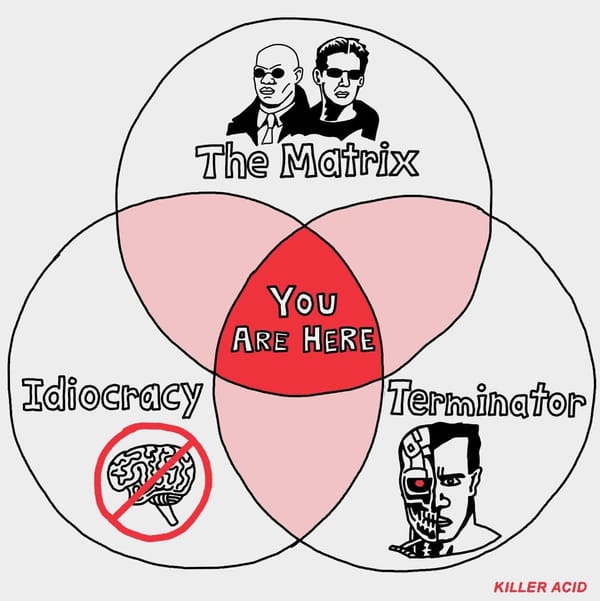
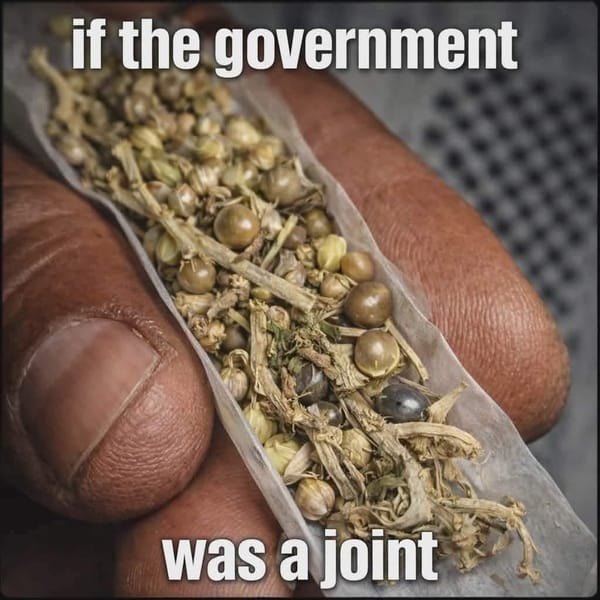
They Cannot Eat Capital or Breathe Authority
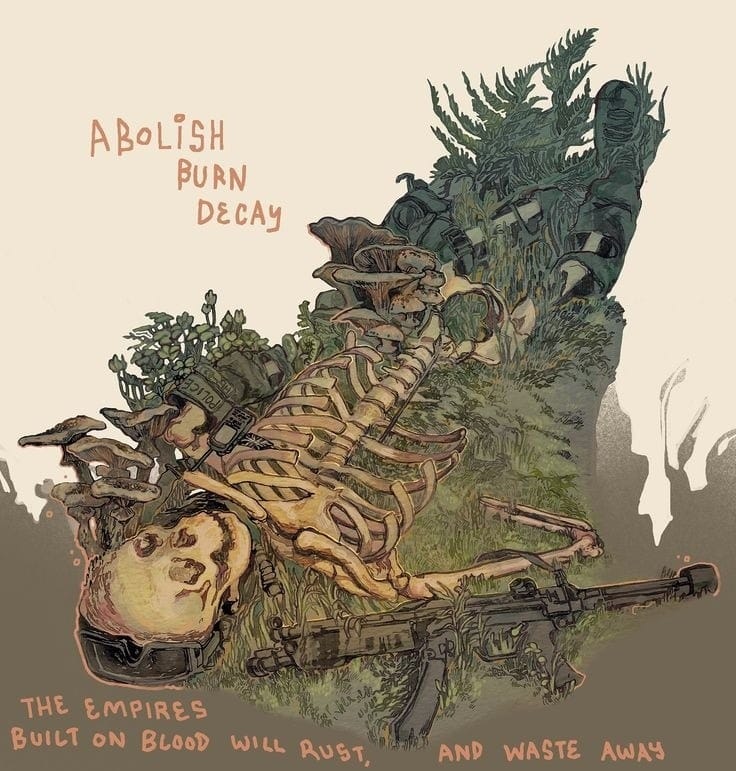
By Harmonious Jackalope
This paper examines the nature and legitimacy of political power, both historically and in the present moment, with particular attention to the growing divergence between elite interests and public welfare. It begins from the ethical and political premise that government is legitimate only insofar as it protects the most vulnerable within society (Bookchin, 1982; Davis, 2003). Historically, the wealthy have not depended on public institutions for survival, instead securing their safety through private capital, coercive force, and influence over state mechanisms (Graeber, 2011). As contemporary governance increasingly prioritizes the preservation of elite control over the well-being of the broader population, we witness a shift toward authoritarian strategies: surveillance, carceral expansion, economic dispossession, and militarized policing (Davis, 2003; Gilmore, 2007).
Yet this imbalance reveals a deeper contradiction: the elite may hold institutional power, but they remain intrinsically tied to the labor, consumption, and cooperation of the majority to sustain their position (Graeber, 2011). True power, therefore, lies not in wealth or weapons, but in the collective capacity of the people to withhold consent, disrupt systems of exploitation, and imagine new forms of life. The sheer numerical and material dependence of the elite upon the working and marginalized classes exposes a central instability in the current order—one that cannot be resolved through force alone. While the ruling class may attempt to manufacture scarcity, impose obedience, or fragment solidarity, they cannot survive without the very people they seek to dominate. We, on the other hand, can survive without them.
Where Power Truly Resides
While modern states often appear to possess totalizing power—backed by wealth, surveillance, and militarized force—their authority is structurally dependent on the compliance, labor, and social cohesion of the governed (Foucault, 1977; Graeber, 2011). The elite, though insulated by privilege, remain materially reliant on those they seek to control. They do not grow food, maintain infrastructure, educate youth, care for the sick, or carry out the essential functions of social reproduction (Federici, 2012). This asymmetry exposes a deeper truth: the majority can survive without the ruling class, but the ruling class cannot survive without the majority.
Historically, movements for liberation have understood and acted upon this principle. In the late 1960s and early 1970s, the Black Panther Party for Self-Defense and the American Indian Movement (AIM) each mounted powerful challenges to the myth of elite indispensability. These organizations did not merely protest injustice—they built alternative institutions that revealed the fragility of state legitimacy and the latent power of self-organized communities (Churchill & Vander Wall, 2002).
The Black Panther Party, founded in Oakland in 1966, recognized that the state was failing—often violently refusing—to serve Black communities. In response, the Panthers established community survival programs: free breakfast for children, health clinics, educational programs, and self-defense patrols to monitor police brutality (Newton, 1972). These were not acts of charity; they were demonstrations of political capacity. They showed that communities long marginalized and criminalized by the state were not powerless—they were self-sufficient when given the space and tools to organize. The state’s violent repression of the Panthers—through FBI surveillance, disinformation, and targeted assassinations—was not a response to chaos, but to the threat of autonomy (Churchill & Vander Wall, 2002). The Panthers exposed that the state did not fear crime; it feared competition for legitimacy.
Similarly, the American Indian Movement, established in 1968, emerged as a response to centuries of broken treaties, forced displacement, and cultural erasure (Smith & Warrior, 1996). AIM asserted Indigenous sovereignty through direct action and occupation: most famously at Wounded Knee in 1973, where activists held federal agents at bay for 71 days while demanding the fulfillment of treaty obligations and the recognition of Indigenous autonomy (Smith & Warrior, 1996). Like the Panthers, AIM combined radical critique with community empowerment, organizing patrols against police violence and advocating for the return of stolen land. Their resistance made clear that U.S. power was not invincible—it depended on the continued erasure of Indigenous claims and the fragmentation of Indigenous solidarity.
Both movements revealed a foundational contradiction: that the U.S. state, while projecting strength, relies on the managed dispossession of precisely those it claims to represent (Gilmore, 2007). When marginalized communities reclaim their labor, their bodies, and their futures, they unmask the performative nature of elite authority. The Panthers and AIM did not just demand inclusion—they demonstrated a capacity to build power independently, and in doing so, became targets of state violence designed to preserve the illusion that all power flows from above.
What these histories teach is that power is not synonymous with domination. It is relational (Foucault, 1977). The elites have wealth and enforcement, but the people have numbers, labor, and legitimacy. This is not merely theoretical—it is a condition of survival. In times of crisis, it is not hedge fund managers or senators who keep society functioning; it is nurses, teachers, farmers, caregivers, builders, and organizers (Federici, 2012). The continued rule of the elite requires suppressing this truth, through debt, incarceration, propaganda, and fear (Graeber, 2011). But the moment the governed recognize their own centrality, the balance shifts.
Reclaiming Power in the Present
The dynamics that targeted and dismantled the Black Panther Party and the American Indian Movement did not end with COINTELPRO or the Cold War. They were refined, expanded, and embedded into the fabric of 21st-century governance (Churchill & Vander Wall, 2002). Today, the logic of state repression persists in new forms: mass incarceration has replaced open political imprisonment, predictive policing has digitized racial profiling, and social media platforms function as both surveillance tools and mechanisms of behavioral control (Davis, 2003; Zuboff, 2019). What once required armies now occurs through algorithms.
At the same time, capitalism has entered a stage of extreme consolidation, where fewer hands control more wealth, land, and data than at any point in modern history (Piketty, 2014). The state, once imagined as a public counterweight to private power, now frequently functions as its enforcer—facilitating evictions, criminalizing poverty, and shielding corporate interests from democratic oversight (Gilmore, 2007). In this landscape, traditional forms of political participation—voting, petitions, appeals to elected officials—have been rendered structurally impotent, even as they are still ritually encouraged (Graeber, 2011). The crisis, then, is not only one of representation but of material survival and legitimacy.
And yet, the central contradiction remains: the ruling class depends on the compliance and labor of the very people it exploits. This dependence is the basis of counter-power. The question is not whether the people possess power—it is whether we are organized to wield it.
Organizational Models for Popular Power Today
To reclaim power in the present requires building autonomous, resilient, and federated forms of social organization capable of both confronting existing systems and prefiguring alternatives (Bookchin, 1982; Spade, 2020).
1. Dual Power Structures
Borrowing from revolutionary socialist traditions, the concept of dual power refers to creating parallel institutions that serve community needs while challenging the legitimacy of the dominant system (Lenin, 1917/1964). In the modern context, this could take the form of:
- Tenant unions resisting evictions and reclaiming housing as a human right
- Mutual aid networks providing food, care, and supplies outside of market or state control
- Community land trusts that decommodify land and protect against gentrification
- Copwatch collectives and people’s assemblies exercising local accountability and democratic decision-making
Dual power is not a symbolic protest—it is a strategy of displacement, where the people begin to govern themselves in the shell of the old system.
2. Platform Cooperatives and Digital Commons
In an age where data is capital, digital infrastructure must be reclaimed (Zuboff, 2019). Platform cooperatives offer an alternative to exploitative gig economies, allowing workers to own and control the digital platforms they rely on (Scholz, 2016). Similarly, the digital commons—open-source tools, decentralized networks, encrypted communications—enable people to organize without surveillance and to build digital spaces that serve public, not corporate, interests.
This echoes the Black Panther Party’s use of print media and AIM’s use of radio and direct communication—but updated for an era where information control is central to power.
3. Decentralized and Intersectional Coalition-Building
No single organization can represent “the people,” but coalitions of autonomous, grassroots movements can (Spade, 2020). Movements like Black Lives Matter, Indigenous land defense camps, prison abolition networks, and climate justice organizations already operate with decentralized leadership, horizontal accountability, and shared political commitments.
Rather than aiming for a central authority, these coalitions operate on the principle of solidarity across difference—recognizing that liberation is collective, and that fragmentation is one of the primary tools of elite control (Crenshaw, 1991). These formations embody what AIM called “a nation within a nation,” and what the Panthers referred to as “survival pending revolution” (Newton, 1972).
4. Reparative Economics and Relational Governance
True power reclamation cannot replicate the extractive and hierarchical models of the state. Instead, it must center reparative economics—redistribution of wealth, land, and resources—and relational governance, where authority emerges from care, trust, and accountability, not coercion (Federici, 2012).
This means community-controlled budgets, conflict resolution without police, restorative justice frameworks, and economic models based on use, not profit. These are not utopian fantasies—they exist in practice, in Chiapas, in Rojava, in Jackson, Mississippi (Knapp et al., 2016).
Survival Without Permission: Anarchist Frameworks in a Collapsing World
As climate change accelerates, global systems of governance reveal not just incompetence but strategic abandonment (IPCC, 2022). In the face of fires, floods, crop failure, and mass displacement, states do not prepare to safeguard life—they prepare to secure borders, suppress dissent, and protect capital. In this context, the fusion of corporate and state power—a form of corporate fascism—prioritizes logistical continuity for the wealthy while treating the rest of the population as disposable (Gilmore, 2007).
It is precisely in this reality that anarchist political theory becomes not only relevant but indispensable. Anarchism, long caricatured as chaos or nihilism, is in fact a rigorous tradition of mutual aid, horizontal organization, and autonomous community-building (Kropotkin, 1902/2006). It offers a framework for surviving without state permission, and for sustaining life when extractive systems collapse.
Mutual Aid as Infrastructure
Mutual aid—popularized through the writings of Peter Kropotkin and practiced daily by anarchist communities—replaces charity with solidarity (Kropotkin, 1902/2006; Spade, 2020). In the aftermath of hurricanes, wildfires, and pandemics, it has been mutual aid networks—not governments—that have delivered food, medicine, shelter, and care.
Mutual aid is not a stopgap—it is a parallel infrastructure that refuses dependence on institutions that have abandoned their duty. These networks are inherently subversive because they refuse the monopoly the state and capital claim over life itself. They restore what the state actively suppresses: relational trust, local knowledge, and cooperative agency.
Autonomy Over Authority
In a collapsing ecological and political order, survivability hinges on the capacity to self-organize without centralized control (Bookchin, 1982). Anarchist principles such as federalism, direct democracy, and prefigurative politics reject the idea that liberation can be deferred or managed from above. Instead, they assert that communities can and must govern themselves now, in ways that reflect the world they are trying to build.
Resisting Green Authoritarianism
Anarchist theory also prepares us to resist the coming wave of green authoritarianism—the use of ecological crisis to justify intensified surveillance, resource rationing, eugenics, and border militarization (IPCC, 2022; Zuboff, 2019). If we do not build counter-power, climate collapse will not end capitalism—it will entrench it.
Conclusion: Power, Possibility, and the Refusal to Die Quietly
The question of where power resides is no longer philosophical—it is existential. We live in a time when the combined forces of ecological collapse and corporate fascism are rendering vast portions of the population expendable. State institutions, captured by elite interests, have abandoned even the pretense of care. In their place, we are offered surveillance, austerity, and coercion as substitutes for justice, sustainability, and solidarity.
But the lie at the heart of this order is fragile: the elite are not self-sufficient. They cannot eat capital or breathe authority. They rely on our labor, our consent, our fragmentation. This is where power truly resides—not in boardrooms or parliaments, but in kitchens, clinics, workshops, forests, and the countless spaces where people still care for each other despite every effort to atomize and dehumanize them.
The historical examples of the Black Panther Party and the American Indian Movement show that even in the teeth of state repression, it is possible to build structures that serve the people directly, without mediation or permission (Newton, 1972; Smith & Warrior, 1996). Today, anarchist frameworks carry this spirit forward, offering lifelines for organizing under siege, and tools for creating lives beyond extraction and control.
If we are to survive, it will not be because we reformed the institutions that abandoned us—it will be because we replaced them. With care. With courage. With each other. Power is already in our hands. The task is not to seize it, but to remember it, to organize it, and to live like it’s already ours.
References
Bookchin, M. (1982). The ecology of freedom: The emergence and dissolution of hierarchy. Cheshire Books.
Churchill, W., & Vander Wall, J. (2002). The COINTELPRO papers: Documents from the FBI’s secret wars against dissent in the United States. South End Press.
Crenshaw, K. (1991). Mapping the margins: Intersectionality, identity politics, and violence against women of color. Stanford Law Review, 43(6), 1241–1299.
Davis, A. Y. (2003). Are prisons obsolete? Seven Stories Press.
Federici, S. (2012). Revolution at point zero: Housework, reproduction, and feminist struggle. PM Press.
Foucault, M. (1977). Discipline and punish: The birth of the prison. Pantheon Books.
Gilmore, R. W. (2007). Golden gulag: Prisons, surplus, crisis, and opposition in globalizing California. University of California Press.
Graeber, D. (2011). Debt: The first 5,000 years. Melville House.
Intergovernmental Panel on Climate Change. (2022). Climate change 2022: Impacts, adaptation, and vulnerability. Cambridge University Press.
Knapp, M., Flach, A., & Ayboga, E. (2016). Revolution in Rojava: Democratic autonomy and women’s liberation in Syrian Kurdistan. Pluto Press.
Kropotkin, P. (2006). Mutual aid: A factor of evolution (Original work published 1902). McClure, Phillips & Co.
Lenin, V. I. (1964). The dual power (Original work published 1917). Progress Publishers.
Newton, H. P. (1972). Revolutionary suicide. Harcourt Brace Jovanovich.
Piketty, T. (2014). Capital in the twenty-first century. Harvard University Press.
Scholz, T. (2016). Platform cooperativism: Challenging the corporate sharing economy. Rosa Luxemburg Stiftung.
Smith, P. C., & Warrior, R. A. (1996). Like a hurricane: The Indian movement from Alcatraz to Wounded Knee. The New Press.
Spade, D. (2020). Mutual aid: Building solidarity during this crisis (and the next). Verso.
Zuboff, S. (2019). The age of surveillance capitalism. PublicAffairs.